Now that the weather is getting warmer, you’re bound to spend more time outside planting your garden and fixing up your outdoor décor. One aspect of your outdoor space that you definitely don’t want to overlook this spring is landscape lighting!
Landscape Lighting Terms
Before we dive into landscape lighting design, there are some terms you’ll need to know.
PATH LIGHTING lights your walkways to or from your door. Not only is this a great safety feature that makes it easy for guests to get to and from your door in the dark, it also adds stylistic appeal to your yard space!
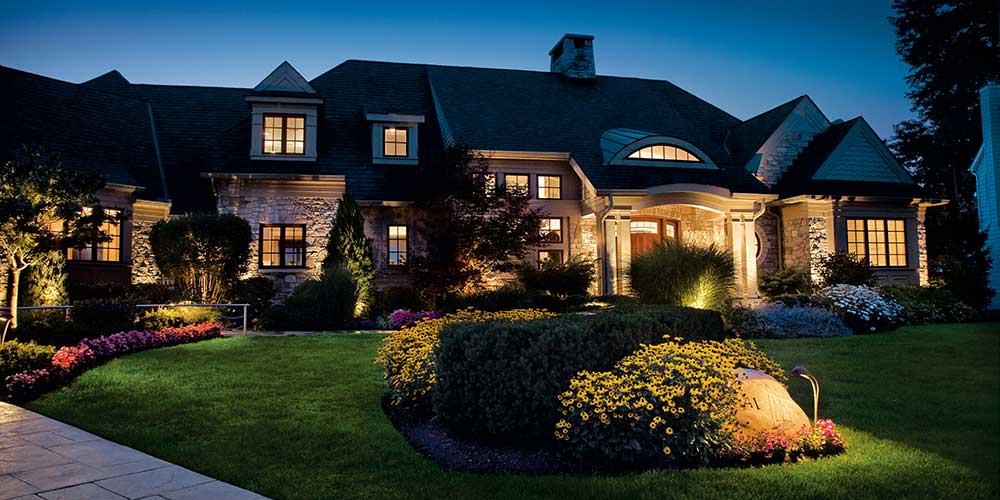
WALL WASHING refers to lighting the sides of your house. Specifically, wall washing refers to lighting all or most of the wall. If you have cobblestone or brick details that you want to highlight, you may want to consider wall washing to add aesthetic appeal to your home!
WALL GRAZING refers to lighting only part of your house (less than wall washing). This can be used to highlight specific details of your home’s architecture, such as columns or wall art.
SHADOWING is when you add light to something in order to create a shadow behind it. Sometimes landscape lighting design is about what you don’t illuminate! You can also use shadowing in your landscaping to hide things you don’t want to be immediately visible—for example, if you have a pool pump that you would rather not highlight, you can use shadowing to light something in front of the pump to cast it in shadows and obscure it from your guests’ view!
UPLIGHTING means placing a light in front of an object to highlight it. Uplighting can be combined with shadowing for a multi-layered effect that makes your highlight really pop!
SILHOUETTING means placing a light behind an object to highlight it. This is especially useful if you want to (as the name suggests) emphasize the silhouette of an object rather than the specific details of the object. This is great for manicured bushes where you want people to focus on the shape rather than the bush itself.
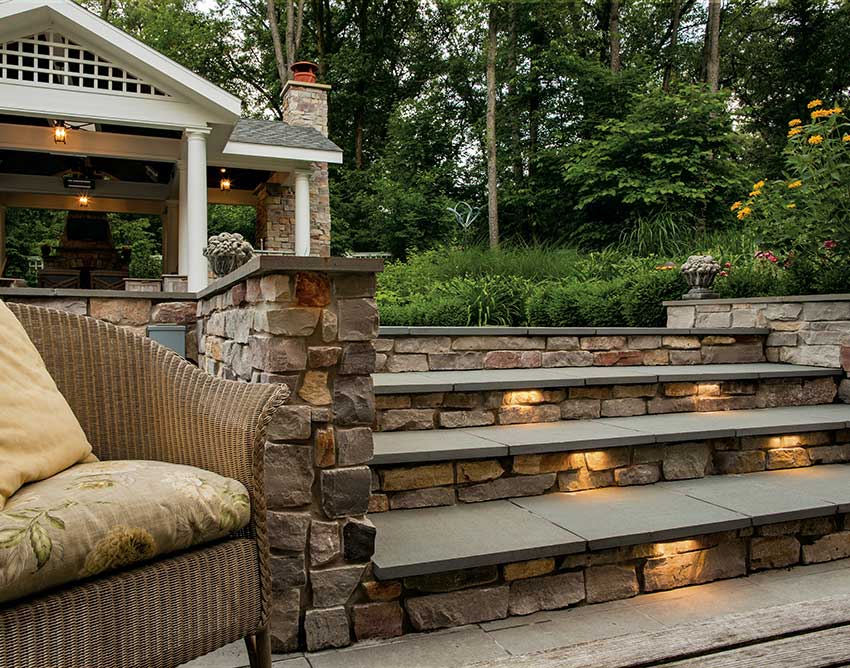
STEP LIGHTING lights your patio or porch steps. Step lighting is a great safety feature for after dark, as it will help your guests avoid tripping over stairs.
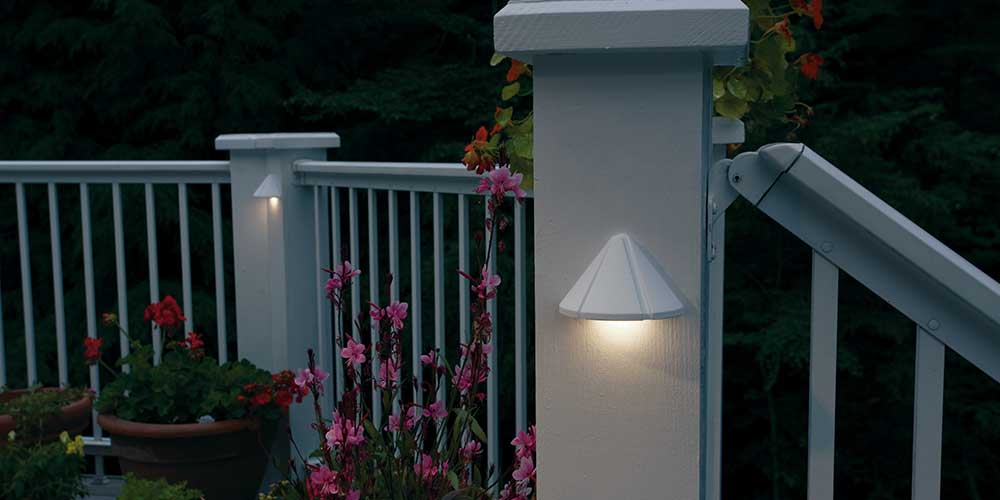
DECK LIGHTING lights your deck, and can include posts and/or steps. If you don’t want to install a larger outdoor lighting fixture on your deck, deck lighting (possibly combined with an LED lit umbrella) can provide the lighting you need.
IN-GROUND LIGHTING fixtures are installed beneath ground level. These lights are commonly used under trees or in and around pools when rated for water usage—always check before installation in a wet area!
HARDSCAPE LIGHTING lights inanimate features of your landscaping, like boulders, fountains, or other lawn and yard accessories that you want to highlight.
SOFTSCAPE LIGHTING lights living features of your landscaping, like trees and bushes.
VOLTAGE RATING refers to the voltage that is recommended for safe usage of the light.
STANDARD WATTAGE is the amount of watts you can use before triggering the breaker.
Knowing these terms can make conveying your landscape lighting design ideas to your contractor or designer much easier, and can make looking for inspiration quick and simple.
What to Look For When Buying Outdoor Lighting
There’s a lot to consider when buying any light, but outdoor lighting—and by extension, landscape lighting—has some additional factors to consider:
Whenever you install a light fixture outdoors, you have to be aware of the risk of exposure to moisture. Be it wind, dew, or rain, the outdoors will expose your light to weather conditions not typically found indoors. For this reason, you should only install light fixtures that are UL rated for wet locations outdoors to make sure they’re built for the environment. UL, or underwriter’s laboratory, is a trusted resource across the globe for product safety certification and compliance solutions, so a fixture with a UL rating for wet locations is guaranteed to be safe in a high-moisture environment like the outdoors during the rainy season.
You also want your landscape lighting to be durable. At canadalightingexperts, we believe in transparency when it comes to the materials used in the products we sell and will share that information with our customers as much as possible to help you make the decision that’s right for your yard. If you ever have any questions about the materials used in a fixture and their durability, just call Us: 1-866-203-5392 and we’ll get the information for you!
Lastly, one more unique aspect of outdoor/landscape lighting is Dark Sky Compliance. Essentially, Dark Sky Compliant fixtures face light downward, rather than spreading light up toward the sky. Of course, most people agree that light should face down to illuminate the space where you’re walking and where you need to see as opposed to shining up into the dark night sky. Many cities across the US have enacted Dark Sky Ordinances to reduce light pollution and help urban dwellers see the stars from their homes. This is mandatory in some places, so make sure you check your local laws to make sure your fixtures are in compliance. Several of our popular fixtures are Dark Sky Compliant!
With any electrical fixture, you also want to be mindful of the voltage and wattage. Wattage is a measurement of electric power. Voltage refers to the electric charge which is carried by your property’s electric circuits. For safety purposes, it is important to understand the voltage produced by your electric circuits and the voltage your electric fixtures can safely work with. The US standard is 120 volts.
Another factor to consider with wattage is the use of LED lights. LED landscape lights are a great solution not only because they lower your energy bill, but because they are long-lasting lights. LED lights are able to achieve the same amount of lighting output with less watts than incandescent or fluorescent bulbs, making LED landscape lights more efficient.
How to Light Your Landscaping
Now that you know all the terms and different factors to consider when setting up your landscape lighting, it’s time to plan your landscape lighting design! We recommend mapping out your yard, including the dimensions of any patio space or pathways, trees, pools, and any other major landscaping features.
For safety, we recommend lighting your walkways with pathway lighting. Pathway lights should be placed at least every six to eight feet from each other, but you can place more pathway lights closer together if you want to create a particularly bright walkway. This is ideal if you have an uneven pathway surface, such as cobblestone or brick, so your visitors can easily see tripping hazards and avoid them. Wall washing is also a great way to use lighting for security, as it can prevent potential intruders from hiding in shadows around the sides of your home that are not frequently lit. Installing well lights in your pool and in-ground lighting around it will also help prevent your guests slipping and falling in for an unwanted swim! Lastly, step/deck lighting should be used anywhere you have outdoor stairs to help your guests avoid tripping over stairs or falling over the sides of raised decks by clearly showing them where the potential hazards are.
For aesthetic purposes, we recommend shadowing, uplighting, or silhouetting as you see fit for landscape elements like boulders, trees, rosebushes, etc. Which technique you decide to use will depend on your unique tastes and the spacing of these elements from each other/the house (for example, silhouetting a tree that’s growing right next to your home may not work very well as the light may not have the spacing needed to create a strong silhouette).
No matter how you choose to light your landscaping, there are styles of all kinds to match your indoor lighting aesthetic and outdoor fixtures like porch lights and outdoor wall-mounted fixtures. Here at 1Stop lighting we pride ourselves on our unparalleled selection – if you want it, there’s a good chance that we have it and at an amazing price