How Does a Patio Heater Work? A Look at the Inner Workings
It’s no surprise that here at Canada Lighting Experts we L-O-V-E spending time outdoors with our family and guests, so much so that we focus our working lives on making sure our customers are comfortable outdoors in just about any weather. One of the key ingredients to patio/deck happiness is keeping the temperature of your patio just right, and by far the best way to do this is to use one of our patio heaters to keep the party rolling long into the night.
But, like all things mechanical, there are times when something’s not right. Perhaps it won’t start, the pilot won’t stay lit, or it just plain isn’t heating like it used to… but something’s definitely not right. Don’t worry… we’ve got you. We asked our theam of patio experts for their tips on how to fix your patio heater. Here’s what they found:
Signs Your Patio Heater Needs help
It’s the perfect morning… a little chilly, but there are wispy clouds in the sky foreshadowing a gorgeous day ahead as the sun slowly peaks from over the horizon. You’ve got your ridiculously large mug of coffee, and it’s time to start your morning with a little Zen meditation (or maybe just caffeine overload, we won’t judge). As you step out onto your patio you immediately realize you need a little warmth, so you step to your trusty patio heater and start ‘er up. Only it won’t start… you do what any reasonable person would do – you bang it on the side hoping to fix the problem. Nope, still not working.
Here are some common signs your patio heater isn’t working correctly:
- It won’t start
- (Gas heaters) Ignition switch won’t light the heater, but a match or lighter will
- It runs, but the flame is noticeably smaller than normal
- It runs for just a few minutes then stops
- The heat output is lower than normal
Basic steps to repair all types of heaters
1. Check the Fuel Source
- Electric: Make sure the breaker is on
- Natural Gas: Make sure there is no kink in the gas line
- Propane: Make sure the cylinder isn’t empty and regulator is on and working OK
2. Clear Debris
- Clear debris around the burner pilot
3. Check for Critters and Evict Them
- Especially on first use in the season
- Bugs and small animals tend to nest in heaters
4. Check the Gas Tank
- Make sure there’s fuel in the cylinder
- Ensure that the regulator is fitted correctly and that it’s the right type for the cylinder
- Note: Cold weather (below 6° Fahrenheit) requires use of a propane cylinder, as butane struggles at low temperatures
5. Vent the Gas Hose
Turn the gas cylinder ON, turn the gas knob to “pilot” and hold for 90 seconds
- Turn the gas knob to “On” but don’t light it, then turn to “Off”
- Finally, turn back to “Pilot,” click on the ignitor and hold for 30 seconds.
- Slowly release the button and try not to shake the pole (on some heaters this is an issue)
6. Check the Burner
- Remove the LPG hose and check for a blockage
- If you can, use a blower to blow through the LPG hose to be sure it’s clear
- Remove the flame emitter screen (remove the screws holding it in place)
- Check the piezo ignitor spark and thermocouple for signs of carbon build-up
- Clean any carbon build-up, debris, insects, or water from the area
4. Check the Ignition/Test that the Piezo is Sparking Properly
- Test that the piezo is sparking properly
- Turn the gas OFF and push the igniter, you should see a spark
- Test the piezo by removing the ignition lead at the rear of the ignitor, place your thumb over the end and press the red button… you should feel a small sting. Replace the ignition lead
- Igniter should be close to the thermocouple. If it has become dislodged adjust it until the spark is closer to the thermocouple
- If igniter isn’t sparking, a new igniter should be ordered from the manufacturer and replaced in the unit (universal patio heater ignitors are also available)
5. Check the Anti-Tilt Switch
- If your heater has a tilt switch, it is intended to prevent the LP gas from entering the control valve if it senses that the unit has tipped
- Older heaters have a factory fitted mercury tilt switch, while newer models have a mechanical tilt switch type A (very simple to replace)
- If found to be faulty, replace the tilt switch
6. Replace Defective Valves
- Remove the electromagnetic valve (typically at the rear of the gas control valve)
- Inspect for damage
- There is no real test; these valves can be damaged by frost and weather
- Replace the valve with a new one
7. Check all of the Connections, Perform a Leakage Test
- Make a soapy solution of one part dishwashing soap and one part water
- Apply the solution (with a clean spray bottle or a clean paint brush)
- Turn on the LP gas supply, but DO NOT light the burner (make sure the valve is OFF on the heater)
- If a leak is found, tighten any fittings and use plumber’s tape to seal
- Retest the newly sealed fitting until no leaks are present
- Make sure the gas is OFF, push the igniter… you should see a spark
- No spark? Remove the ignition lead on the rear of the ignitor and place your thumb over the end of the igniter and push the ignite button… you should feel a little sting
- Make sure that the igniter is close to the thermocouple, use some pliers to move it closer if it seems to be dislodged
- If still not igniting, a new igniter should be purchased (either from the manufacturer directly or by purchasing a universal patio heater igniter)
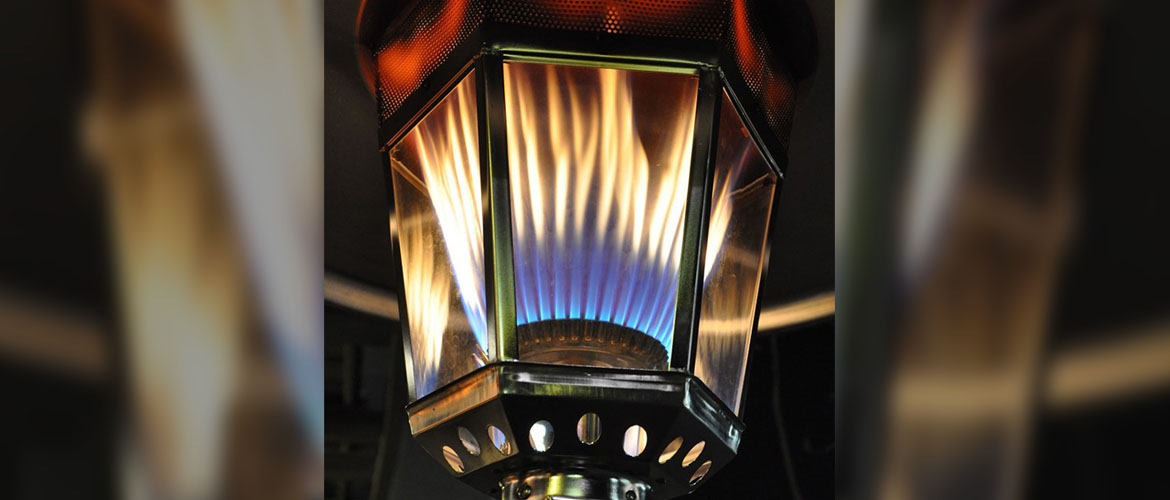
Typically, a lower-than-normal heat output means something is in the way. Dirt, dust, leaves, insects (dead or alive) and other debris will decrease the gas flow, which in turn decreases your heat output.
Heater won’t start, or gives off less heat than normal
- Turn OFF the gas
- Remove the emitter screen (typically a few screws hold it on)
- DO NOT USE WATER or a damp cloth to clean your heater; use compressed air or a pipe or straw brush
- Clean off the emitter screen and the ignition element
If still not fixed, you may have a damaged gas line.
1. Visually inspect the gas lines for cracks, kinks or other abnormalities.
2. Perform a leakage test
- Make a soapy solution of one part dishwashing soap and one part water
- Apply the solution (with a clean spray bottle or a clean paint brush)
- Turn on the LP gas supply, but DO NOT light the burner (make sure the valve is OFF on the heater)
- If a leak is found, tighten any fittings and use plumber’s tape to seal
- Retest the newly sealed fitting until no leaks are present
- If you have damaged gas lines, replace them
The table is set, your guests are arriving, your patio heater is warming the area nicely… wait… it just shut off. There’s propane in the tank, so what’s going on?
If your patio heater shuts down after running a little while, the typical cause for this is that the light flame has become too far away from the thermocouple unit. The thermocouple will turn off the gas because it thinks that the pilot light is out.
Repairing an electric patio heater
1. Ummm… is it plugged in?
- If your patio heater plugs in to current, verify that the cord is solidly seated
2. Check the fuse
- Many electric patio heaters come with built-in fuses to protect the system from accidental overloads
- Check the fuse and replace it if necessary
- If your heater blows fuses frequently, there is an underlying problem that needs to be fixed (or it’s time for a replacement heater)
3. Reset the Reset
- Some electric patio heaters have reset buttons (think of a circuit breaker reset) …
- Push it and restart your heater
4. Heating Element Issues
- Heating elements in electric patio heaters aren’t meant to last forever – for most heaters, the expected lifetime is up to 5,000 hours
- Check your element to see if it is damaged
- No physical damage? Switch off the power and check the connections of the element
- If you have the ability, check the resistance of the element (should be around 10 ohms)
- If not functioning at this point, replace the element with a new one from the manufacturer
Wrap-Up
Patio heaters are our friends, and like any friend when they’re not feeling well, we want to help. Following many of these easy fix-it methods will help to ensure that your patio heater lives a long, happy life consistently warming your family and friends when they need it the most.
You can always rely on Canada Lighting Experts to provide you with tons of patio heating options, and we’re got experts on our end of the phone ready to help you whenever you need it. We love matching up the perfect patio heaters with the needs of our customers, and when your heaters need a little TLC we’re there for you.