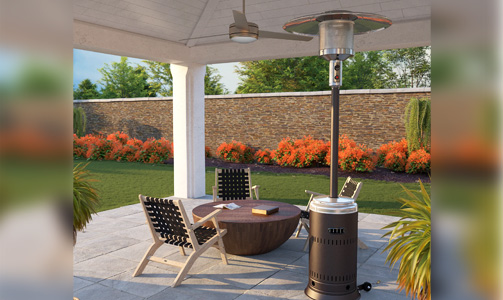
When you see people’s backyards, you’ll find most people heat their patios with what we in the biz politely call “mushroom heaters.” Liquid Propane heaters are heaters that are freestanding, have a wide circular base (that hides a 20 lb. propane canister beneath it), central pole, and a capped top from which the heat radiates in a 360° pattern. Although easily the most expensive patio heater to operate (and the most annoying, as you need to swap out propane cylinders when the heater runs low), the low initial cost, portability and ease-of-use of these patio staples make them an easy choice for casual users, or those who don’t understand the added value of the larger natural gas and electric options in the long term.
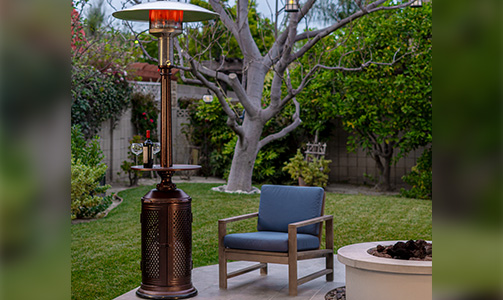
Mushroom heaters work by taking the fuel provided by a 20 lb. propane tank up to the top of the heater (the “head”), igniting the propane and directing the flames upward against a metal screen with perforations in it. A reflector at the top of the burner (typically plated in silver which retains heat poorly but reflects infrared radiation well) redirects the radiation downward, providing additional infrared heating and some convection heating to the guests below. Because mushroom heaters provide heat in a circular pattern, they are best used in the center of an area to be heated and not recommended for direct heat (like where you are trying to heat a dining space).
What’ll you find inside your mushroom heater? Here are some of the major components:
- Gas Regulator – Connects the gas hose to the propane cylinder, it controls how much gas is released to the heater
- Ignition – No match or lighter required; modern heaters have a piezo ignition key that produces electric sparks to initiate the flame
- Thermocouples – Designed to prevent accidental gas leaks (and fend off a major safety hazard), thermocouples keep the valve closed until the requisite temperature is reached for flame ignition (sometimes with a slight 10-30 second delay before the heater kicks on completely)
Natural gas heaters work almost identically to the mushroom heater discussion above, only with a more permanent installation (as they must be plumbed to a gas line) and they have larger components. Natural gas heaters are the most expensive to purchase and install but are easily the least expensive to run day-to-day. A propane heater (at about 40,000 BTU) will cost about $1.70 per hour to run, while a natural gas heater of the same size will cost about $0.50 per hour… significant savings if you plan on using your patio heater frequently.

How do electric patio heaters work?
While natural gas and propane products take the fuel source and use it to transfer fire into infrared heat, electricity does not. Electric patio heaters use electricity to energize an emitter, which then throws off infrared rays that warm people and objects directly.
Because electric patio heaters require installation by a professional, they are right in the middle ground on price. Mushroom heaters are low cost initially, and expensive to run every day. Natural gas heaters are expensive to purchase and install but have the lowest operating costs. Electric heaters are in the sweet spot in the middle – medium priced and medium cost of daily use.
Because electric heaters aren’t burning gasses like the other two, they don’t require any special ventilation (in fact, you could use them indoors if needed). Additionally, because you’re not burning gasses, wind doesn’t affect the heat output from your patio heater.
How effective is a patio heater?
To us, an “effective” patio heater is one that keeps us comfy when we need it. That’s a nice thought but putting that into empirical numbers is a little bit tough.
Let’s try this… to figure out how much heat you need (usually measured in British Thermal Units or BTUs) you need a simple formula:
Total Cubic Feet X Preferred # of Degrees (F) Change = BTUs Needed:
If your patio is 20’ x 10’ and we assume the heating level to be 7’ tall, that would be 1,400 cubic feet (20 x 10 x 7). If the temperature is 45° and we want to feel like 65°, we would have a 20° difference. Per the formula CUBIC FEET x TEMP DIFF = BTUs we would get 1,400 x 20 = 28,000 BTUs. If the patio heater we select handles a heat disbursement area of 20’ x 10’ and is at least 28,000 BTUs, we should be good to go.
This method works fantastically if you’re looking at a gas (propane or natural gas) heater, but electric heaters aren’t typically rated by BTUs. More frequently, electric heaters will give you a square footage (like 121 sq. ft.) of coverage… per heater… so check your square footage (in our example our 20’ x 10’ patio yields 200 sq. ft).
Remember that you’re not limited to one heater. It’s very feasible (even probable) that to adequately heat your outdoor space you may need multiple heaters to cover your loved ones appropriately. Two or three smaller output heaters will cover certain spaces much better than one humongous one – more even coverage with no particular “hot” spots.
Most patio heaters sold today can heat a minimum of 100 sq. ft. (enough to cover the average 10’ x 10’ patio), so small patio users can select based on other criteria than coverage.
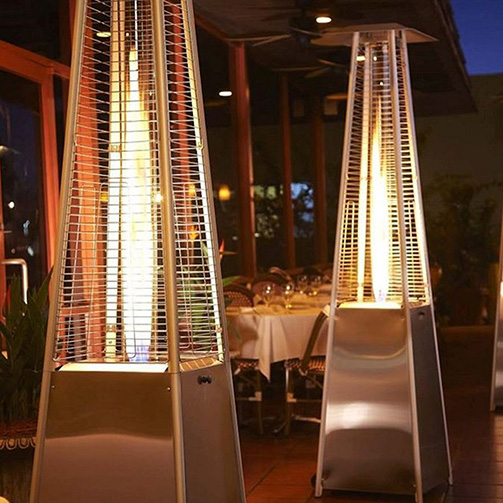
Patio heaters work by heating either the air around you, or by using infrared rays to warm you directly. Propane heaters are portable, inexpensive to purchase and expensive to run day-to-day. Electric heaters hit the medium ground here, while natural gas heaters hit you heavily up front but lighten up on your wallet as time goes on.
Patio heaters can make a fundamental difference in how and when you use your outdoor living spaces, allowing for significantly more time to enjoy your outdoor oasis. Patio heaters work by heating either the air around you, or by using infrared rays to warm you directly. Propane heaters are portable, inexpensive to purchase and expensive to run day-to-day. Electric heaters hit the medium ground here, while gas heaters hit you heavily up front but lighten up on your wallet as time goes on.